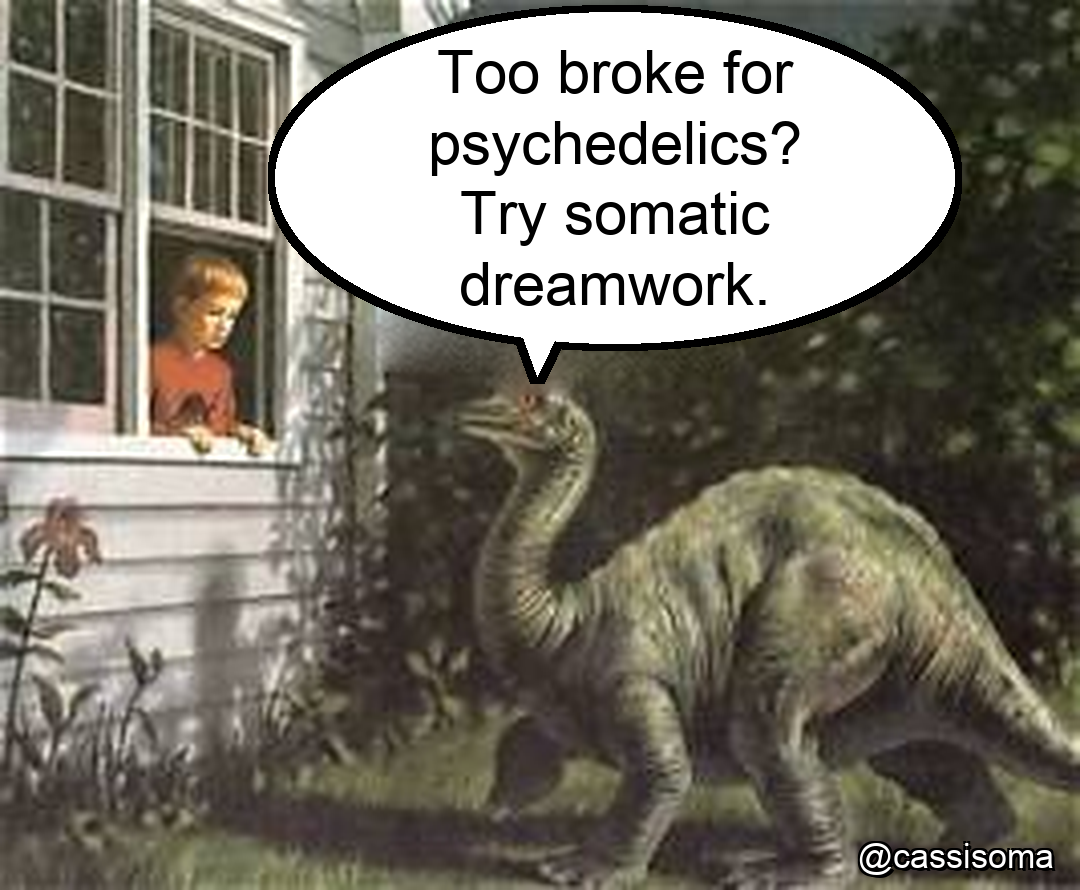
I practice both psychedelic-assisted psychotherapy and somatic dreamwork. Both have incredible healing potential. But one of them is available every night, to everyone, for free.
I also work in the recovery community, and I’ve been sober since 2019. So I’m especially interested in a question that doesn’t get asked often enough: how do we support the psychedelic experience without the substance?
What “psychedelic” actually means
The word is younger than most people assume. Psychiatrist Humphry Osmond coined it in 1956, from the Greek psychē — mind, soul — and dēloun, to make visible, to reveal.
Mind-manifesting. That’s the whole definition.
Notice what isn’t in it. There’s no drug in that word. Osmond was naming a state of consciousness, not the thing you swallow to get there. He even offered it as a couplet: “To fathom Hell or soar angelic, just take a pinch of psychedelic.”
The pinch is one route. It was never the definition.
That distinction matters enormously if you’re in recovery, or if substances are off the table for you medically, or if you simply can’t spend four figures on a session. Because a mind-manifesting state that costs nothing and breaks no sobriety is not a consolation prize. It’s the same territory, reached on foot.
Somatic dreamwork is psychedelic and substance-free.
The overlap nobody mentions
Psychedelics and dreams are not the same thing. I want to be clear about that up front — different mechanisms, different intensity, different risks.
But look at what they share. In both, the ordinary self-narrating mind loosens its grip. Images arrive that you did not consciously author. Time behaves strangely. Emotion comes through unfiltered, attached to symbols instead of explanations. Things you have been carefully not thinking about walk right up to you.
That’s not a small overlap. That’s most of why people seek out a non-ordinary state in the first place.
The difference is that one of them requires a facilitator, a date on the calendar, and a four-figure payment. The other one happened to you last night.
What the free one asks instead
Dreams don’t cost money. They cost attention, which for a lot of us is harder.
A psychedelic session compresses everything into one overwhelming day and then hands you months of integration. Dreams run the opposite way: a small dose, every night, for the rest of your life. Nobody hands you the material. You have to catch it.
That’s the actual barrier. Not access — recall. A dream will sit with you for about ninety seconds after waking and then dissolve into the day.
So the practice starts embarrassingly simple. Something to write on, within arm’s reach. Before you check your phone, before you get up, before the day’s first thought arrives with its list. Catch one image. One is enough.
Where the body comes in
Here’s where “somatic” stops being a buzzword.
The temptation with a caught dream is to move straight to decoding. What does the snake mean, what does the flooded house mean. That’s the mind doing what it always does — converting the thing into a story it can manage.
Somatic dreamwork goes the other direction. You go back into the image and find out where it lives in you.
The flooded house — where is that in your body right now? Chest? Throat? What’s the temperature of it? Does it want to move, curl, push, stay still? Not what does it mean, but what is it doing in here.
You’ll notice the difference immediately. Interpretation makes you feel clever. This makes you feel something.
And this is where the psychedelic comparison actually earns itself. Both work because they get underneath language. A dream you only think about stays a puzzle. A dream you feel in your body becomes information.
What I’m not saying
I’m not saying dreamwork replaces psychedelic-assisted therapy. I offer that work too, and I’ve watched it do things nothing else could. If it’s the right medicine for you, and you can access it safely and legally with real support, go.
I’m not saying dreams are gentler. They can bring up plenty, and if you’re carrying trauma, please do this with someone rather than alone at 3am.
And I’m not telling anyone in recovery what to do with their sobriety. That’s yours. I’m saying that if the substance is closed to you — by choice, by program, by prescription, by cost — the state it points toward is not.
What I’m saying is narrower and, I think, more useful: you already have a nightly non-ordinary state. It is already yours. Nobody has to approve you for it, schedule it, or charge you for it. The only question is whether you catch any of it.
Four or five dreams a night. Free.
If you want a place to start, the Lunar Dream Map is a simple morning practice for catching dreams and noticing where they land in the body.